Skip to content
County Dublin — photo by Unknown authorUnknown author
Ireland › Counties › Dublin

County Dublin

Baile Átha Cliath

Leinster · 369 places · 78 photos · 13 videos

Hero photo: Unknown authorUnknown author · Public domain

About County Dublin

County Dublin (Irish: Contae Bhaile Átha Cliath or Contae Átha Cliath) is a county in Ireland that contains its capital city, Dublin. It is on the island's east coast, in the province of Leinster. Dublin is the longest-established county in Ireland, having been the first part of the island to be shired after the Norman invasion in the late 1100s. The third-smallest county by land area, Dublin is bordered by Meath to the west and north, Kildare to the west, Wicklow to the south and the Irish Sea to the east. The southern part of the county is dominated by the Dublin Mountains, which rise to around 760 metres (2,500 ft) and contain numerous valleys and forest areas, as well as several reservoirs. The county's east coast is punctuated by several bays and inlets, including Rogerstown Estuary, Broadmeadow Estuary, Baldoyle Bay and, most prominently, Dublin Bay. The northern section of the county, today known as Fingal, varies enormously in character, from densely populated suburban towns of the city's commuter belt to flat, fertile plains, which are some of the country's largest horticultural and agricultural hubs. Dublin is Ireland's most populous county, with 1,458,154 inhabitants as of 2022 – about 28% of the Republic of Ireland's population. Dublin city is the capital and largest city of the Republic of Ireland, and the largest city on the island of Ireland. Roughly 9 out of every 10 people in County Dublin lives within Dublin city and its suburbs. Several sizeable towns that are considered separate from the city, such as Rush, Donabate and Balbriggan, are in the far north of the county. Swords, while separated from the city by a green belt around Dublin Airport, is considered a suburban commuter town and an emerging small city. Until 1994, the historic county was governed in two parts, the city council area and the local government area known as County Dublin. That year, the county council area was divided into three new administrative counties: Dún Laoghaire–Rathdown, Fingal and South Dublin. The latter three administrative divisions together with the City Council area form a NUTS III statistical region of Ireland (coded IE061), and County Dublin remains a single administrative unit for the purposes of the courts (including the Dublin County Sheriff, but excluding the bailiwick of the Dublin City Sheriff) and Dublin County combined with Dublin City forms the Judicial County of Dublin, including Dublin Circuit Court, the Dublin County Registrar and the Dublin Metropolitan District Court. Dublin also sees law enforcement (the Garda Dublin metropolitan division) and fire services (Dublin Fire Brigade) administered countywide. Dublin retains a strong identity, and continues to be referred to as both a region and county interchangeably, including at government body level.

Intro from Wikipedia (CC BY-SA 4.0)

Explore Dublin by category

Top 10 must-sees in Dublin

View list page →
1913 Lockout — photo by Unknown authorUnknown author #1

1913 Lockout

The Dublin lock-out was a major industrial dispute between approximately 20,000 workers and 300 employers that took place in Dublin, Ireland. The dispute, lasting from 26 August 1913 to 18 January 1914, is often viewed as the most severe and significant industrial dispute in Irish history. Central to the dispute was the workers' right to unionise.

Popularity
64
Explore place →
Museum National Museum of Ireland, Natural History
#3

National Museum of Ireland, Natural History

The National Museum of Ireland – Natural History (Irish: Ard-Mhúsaem na hÉireann – Stair an Dúlra), sometimes called the Dead Zoo, a branch of the National Museum of Ireland, is housed on Merrion Street in Dublin, Ireland. The museum was built in 1856 for parts of the collection of the Royal Dublin Society and the building and collection were later passed to the State. The Natural History Collection comprised sub-collections for zoology, geology and botany; the geological collections have largely been held in storage from the 1960s, and the botanical collection was moved to National Botanic Gardens in 1970. However, the museum's zoological collection, and its building, have changed little since Victorian times, and it is sometimes described as a "museum of a museum" or a "stately home of death". Admission has been free of charge for decades, and attendance grew from 106,000 in 2007 to over 336,000 in 2017, and 388,000 in 2019, despite chronic staff shortages, and two of its four floors being closed since 2007. After temporary closures due to the COVID-19 pandemic, the museum closed in November 2020 for an indefinite period for major renovations, with the collections being moved over a period of around ten months, as detailed on an official museum Twitter channel. The ground floor reopened in August 2022 but will close when the main renovations commence. The work featured in a television documentary The Dead Zoo in 2022.

Popularity
42
Explore place →
Monument Charles Stewart Parnell Monument
#5

Charles Stewart Parnell Monument

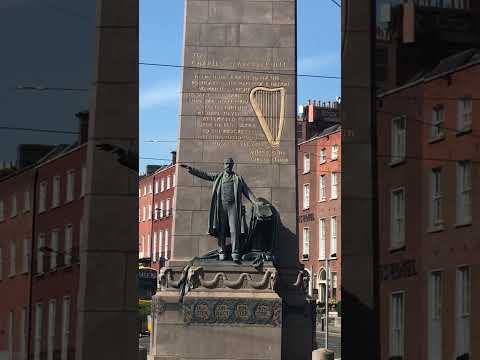
The Parnell Monument is a 19-metre-tall (62 ft) monument to Irish nationalist politician Charles Stewart Parnell (1846–1891), located at the northern end of O'Connell Street in Dublin, Ireland. Designed by Irish-American sculptor Augustus Saint-Gaudens (statue) and American architect Henry Bacon (obelisk), the monument took more than a decade to complete, and was the last public monument Saint-Gaudens saw to completion before his death. It consists of a bronze statue of Parnell set against a large granite obelisk, whose south-facing side bears a gilt inscription of one of his quotations as well as a harp. It was unveiled on 1 October 1911, twenty years after Parnell's death. According to the O'Connell Street Monument Report, the monument "now stands in answer to the O'Connell Statue at the south end and terminates the parade of nationalist statues on the primary thoroughfare of the capital." The monument is within the O'Connell Street Architectural Conservation Area.

Popularity
39
Explore place →
Kenure Portico — photo by Building (Publishers) Ltd. #6

Kenure Portico

Kenure House (Irish: Ceann Iubhair – headland of the yew tree) was a large Georgian house and estate in Rush, County Dublin, Ireland. The main house was constructed between 1703 and 1713 by the Duke of Ormond on the grounds of an earlier house but was destroyed by fire and rebuilt around 1827. A later portico and further additions were added in 1842 to a design by George Papworth. The main house was demolished by Dublin County Council in 1978 and the granite portico is the only portion of the main house which still stands as of 2026.

Popularity
37
Explore place →
General Book of Kells
#8

Book of Kells

The Book of Kells (Latin: Codex Cenannensis; Irish: Leabhar Cheanannais; Library of Trinity College Dublin, MS A. I. [58], sometimes known as the Book of Columba) is an illustrated manuscript and Celtic Gospel book in Latin, containing the four Gospels of the New Testament together with various prefatory texts and tables. It was created in a Columban monastery in Ireland or Scotland, and may have had contributions from various Columban institutions across Ireland and Scotland. It is believed to have been created c. 800 AD. The text of the Gospels is largely drawn from the Vulgate, although it also includes several passages drawn from the earlier versions of the Bible known as the Vetus Latina. It is regarded as a masterwork of Western calligraphy and the pinnacle of Insular illumination. The manuscript is named after Abbey of Kells, County Meath, which was its home for centuries. The illustrations and ornamentation of the Book of Kells surpass those of other Insular Gospel books in extravagance and complexity. The decoration combines traditional Christian iconography with the ornate swirling motifs typical of Insular art. Figures of humans, animals and mythical beasts, together with Celtic knots and interlacing patterns in vibrant colours, enliven the manuscript's pages. Many of these minor decorative elements are imbued with Christian symbolism, and so further emphasise the themes of the major illustrations. The manuscript today comprises 340 leaves or folios; the recto and verso of each leaf total 680 pages. Since 1953, it has been bound in four volumes, 330 by 250 mm (13 by 9.8 in). The leaves are high-quality calf vellum; the unprecedentedly elaborate ornamentation that covers them includes ten full-page illustrations and text pages that are vibrant with decorated initials and interlinear miniatures, marking the furthest extension of the anti-classical and energetic qualities of Insular art. The Insular majuscule script of the text appears to be the work of at least three different scribes. The lettering is in iron gall ink, and the colours used were derived from a wide range of substances, some of which were imported from distant lands. The manuscript is on display to visitors in Trinity College Library, Dublin, and shows two pages at any one time, rotated every 6-8 weeks. A digitised version of the entire manuscript may also be seen online.

Popularity
30
Explore place →
Monument Spanish Civil War International Brigade
#9

Spanish Civil War International Brigade

The International Brigades (Spanish: Brigadas Internacionales) were volunteer soldiers organized by the Communist International to assist the Popular Front government of the Second Spanish Republic during the Spanish Civil War. The International Brigades existed for two years, from 1936 until 1938. It is estimated that during the entire war, there were some 32,000 Brigaders, yet at no single moment were there more than 18,000 actually deployed. Beyond the Spanish Civil War, "International Brigades" is also sometimes used interchangeably with the term foreign legion in reference to military units comprising foreigners who volunteer to fight in the military of another state, often in times of war. The headquarters of the brigade was located at the Gran Hotel, Albacete, Castilla-La Mancha. They participated in the battles of Madrid, Jarama, Guadalajara, Brunete, Belchite, Teruel, Aragon, and the Ebro. Most of these ended in defeat. For the last year of its existence, the International Brigades were integrated into the Spanish Republican Army as part of the Spanish Foreign Legion. The organisation was dissolved on 23 September 1938 by Spanish Prime Minister Juan Negrín in a vain attempt to get more support from the liberal democracies on the Non-Intervention Committee. The International Brigades were strongly supported by the Comintern and represented the Soviet Union's commitment to assisting the Spanish Republic (with arms, logistics, military advisers and the NKVD), just as Portugal, Fascist Italy, and Nazi Germany were assisting the opposing Nationalist insurgency. The largest number of volunteers came from France (where the French Communist Party had many members) and communist exiles from Italy and Germany. Many Jews were part of the brigades, being particularly numerous within the volunteers coming from the United States, Poland, Romania, France, Great Britain, and Argentina. Republican volunteers who were opposed to Stalinism did not join the Brigades. Instead, they enlisted in the separate Popular Front, the POUM (formed from Trotskyist, Bukharinist, and other anti-Stalinist groups, which did not separate Spaniards and foreign volunteers), or anarcho-syndicalist groups such as the Durruti Column, the IWA, and the CNT.

Popularity
30
Explore place →

Videos from Dublin

The 1913 Dublin Lockout DBQ 2026-27 | Leaving Cert History

The 1913 Dublin Lockout DBQ 2026-27 | Leaving Cert History

LCHistoryLM

1913 Lockout →
Ardgillan Castle (County Dublin):  Sites and History

Ardgillan Castle (County Dublin): Sites and History

Life in Europe

Ardgillan Castle →
National Museum of Ireland Natural History. walking Tour

National Museum of Ireland Natural History. walking Tour

RussellFilm

National Museum of Ireland, Natural History →
Dolmen Drumming

Dolmen Drumming

Celtic School of Sound Healing

Aideen's Dolmen →
Seeing the Charles S. Parnell Monument in Dublin Ireland 🇮🇪

Seeing the Charles S. Parnell Monument in Dublin Ireland 🇮🇪

General Tiberiusxx

Charles Stewart Parnell Monument →
Malahide Castle, Malahide, Dublin, Ireland

Malahide Castle, Malahide, Dublin, Ireland

This is Ireland

Malahide Castle →

All places in Dublin

Showing 24 of 369 places

1913 Lockout — photo by Unknown authorUnknown author▶ Video
MonumentDublin

1913 Lockout

The Dublin lock-out was a major industrial dispute between approximately 20,000 workers and 300 employers that took place in Dublin, Ireland. The dispute, lasting from 26 August 1913 to 18 January 1914, is often viewed as the most severe and significant industrial dispute in Irish history. Central to the dispute was the workers' right to unionise.

Ardgillan Castle — photo by GsmithEIDW at English Wikipedia▶ Video
CastleDublin

Ardgillan Castle

Ardgillan Castle is a country house near Balbriggan, County Fingal, Ireland. It is set in the 200-acre (0.81 km2) Ardgillan Demesne (Irish: Ard Giolláin), a public park in the jurisdiction of Fingal County Council.

MuseumNational Museum of Ireland, Natural History
▶ Video
MuseumDublin

National Museum of Ireland, Natural History

The National Museum of Ireland – Natural History (Irish: Ard-Mhúsaem na hÉireann – Stair an Dúlra), sometimes called the Dead Zoo, a branch of the National Museum of Ireland, is housed on Merrion Street in Dublin, Ireland. The museum was built in 1856 for parts of the collection of the Royal Dublin Society and the building and collection were later passed to the State. The Natural History Collection comprised sub-collections for zoology, geology and botany; the geological collections have largely been held in storage from the 1960s, and the botanical collection was moved to National Botanic Gardens in 1970. However, the museum's zoological collection, and its building, have changed little since Victorian times, and it is sometimes described as a "museum of a museum" or a "stately home of death". Admission has been free of charge for decades, and attendance grew from 106,000 in 2007 to over 336,000 in 2017, and 388,000 in 2019, despite chronic staff shortages, and two of its four floors being closed since 2007. After temporary closures due to the COVID-19 pandemic, the museum closed in November 2020 for an indefinite period for major renovations, with the collections being moved over a period of around ten months, as detailed on an official museum Twitter channel. The ground floor reopened in August 2022 but will close when the main renovations commence. The work featured in a television documentary The Dead Zoo in 2022.

Aideen's Dolmen — photo by Wingbat▶ Video
MegalithDublin

Aideen's Dolmen

Aideen's Grave is a collapsed megalithic dolmen (or cromlech) located in the grounds of Howth Castle in County Dublin, Ireland.

MonumentCharles Stewart Parnell Monument
▶ Video
MonumentDublin

Charles Stewart Parnell Monument

The Parnell Monument is a 19-metre-tall (62 ft) monument to Irish nationalist politician Charles Stewart Parnell (1846–1891), located at the northern end of O'Connell Street in Dublin, Ireland. Designed by Irish-American sculptor Augustus Saint-Gaudens (statue) and American architect Henry Bacon (obelisk), the monument took more than a decade to complete, and was the last public monument Saint-Gaudens saw to completion before his death. It consists of a bronze statue of Parnell set against a large granite obelisk, whose south-facing side bears a gilt inscription of one of his quotations as well as a harp. It was unveiled on 1 October 1911, twenty years after Parnell's death. According to the O'Connell Street Monument Report, the monument "now stands in answer to the O'Connell Statue at the south end and terminates the parade of nationalist statues on the primary thoroughfare of the capital." The monument is within the O'Connell Street Architectural Conservation Area.

Kenure Portico — photo by Building (Publishers) Ltd.
MonumentDublin

Kenure Portico

Kenure House (Irish: Ceann Iubhair – headland of the yew tree) was a large Georgian house and estate in Rush, County Dublin, Ireland. The main house was constructed between 1703 and 1713 by the Duke of Ormond on the grounds of an earlier house but was destroyed by fire and rebuilt around 1827. A later portico and further additions were added in 1842 to a design by George Papworth. The main house was demolished by Dublin County Council in 1978 and the granite portico is the only portion of the main house which still stands as of 2026.

Santry Court (In ruins) — photo by Louis Haghe
RuinsDublin

Santry Court (In ruins)

Santry Court was a Georgian house and demesne in Santry, north County Dublin built between 1703 and 1709 on the site of an earlier medieval residence.

GeneralBook of Kells
GeneralDublin

Book of Kells

The Book of Kells (Latin: Codex Cenannensis; Irish: Leabhar Cheanannais; Library of Trinity College Dublin, MS A. I. [58], sometimes known as the Book of Columba) is an illustrated manuscript and Celtic Gospel book in Latin, containing the four Gospels of the New Testament together with various prefatory texts and tables. It was created in a Columban monastery in Ireland or Scotland, and may have had contributions from various Columban institutions across Ireland and Scotland. It is believed to have been created c. 800 AD. The text of the Gospels is largely drawn from the Vulgate, although it also includes several passages drawn from the earlier versions of the Bible known as the Vetus Latina. It is regarded as a masterwork of Western calligraphy and the pinnacle of Insular illumination. The manuscript is named after Abbey of Kells, County Meath, which was its home for centuries. The illustrations and ornamentation of the Book of Kells surpass those of other Insular Gospel books in extravagance and complexity. The decoration combines traditional Christian iconography with the ornate swirling motifs typical of Insular art. Figures of humans, animals and mythical beasts, together with Celtic knots and interlacing patterns in vibrant colours, enliven the manuscript's pages. Many of these minor decorative elements are imbued with Christian symbolism, and so further emphasise the themes of the major illustrations. The manuscript today comprises 340 leaves or folios; the recto and verso of each leaf total 680 pages. Since 1953, it has been bound in four volumes, 330 by 250 mm (13 by 9.8 in). The leaves are high-quality calf vellum; the unprecedentedly elaborate ornamentation that covers them includes ten full-page illustrations and text pages that are vibrant with decorated initials and interlinear miniatures, marking the furthest extension of the anti-classical and energetic qualities of Insular art. The Insular majuscule script of the text appears to be the work of at least three different scribes. The lettering is in iron gall ink, and the colours used were derived from a wide range of substances, some of which were imported from distant lands. The manuscript is on display to visitors in Trinity College Library, Dublin, and shows two pages at any one time, rotated every 6-8 weeks. A digitised version of the entire manuscript may also be seen online.

MonumentSpanish Civil War International Brigade
MonumentDublin

Spanish Civil War International Brigade

The International Brigades (Spanish: Brigadas Internacionales) were volunteer soldiers organized by the Communist International to assist the Popular Front government of the Second Spanish Republic during the Spanish Civil War. The International Brigades existed for two years, from 1936 until 1938. It is estimated that during the entire war, there were some 32,000 Brigaders, yet at no single moment were there more than 18,000 actually deployed. Beyond the Spanish Civil War, "International Brigades" is also sometimes used interchangeably with the term foreign legion in reference to military units comprising foreigners who volunteer to fight in the military of another state, often in times of war. The headquarters of the brigade was located at the Gran Hotel, Albacete, Castilla-La Mancha. They participated in the battles of Madrid, Jarama, Guadalajara, Brunete, Belchite, Teruel, Aragon, and the Ebro. Most of these ended in defeat. For the last year of its existence, the International Brigades were integrated into the Spanish Republican Army as part of the Spanish Foreign Legion. The organisation was dissolved on 23 September 1938 by Spanish Prime Minister Juan Negrín in a vain attempt to get more support from the liberal democracies on the Non-Intervention Committee. The International Brigades were strongly supported by the Comintern and represented the Soviet Union's commitment to assisting the Spanish Republic (with arms, logistics, military advisers and the NKVD), just as Portugal, Fascist Italy, and Nazi Germany were assisting the opposing Nationalist insurgency. The largest number of volunteers came from France (where the French Communist Party had many members) and communist exiles from Italy and Germany. Many Jews were part of the brigades, being particularly numerous within the volunteers coming from the United States, Poland, Romania, France, Great Britain, and Argentina. Republican volunteers who were opposed to Stalinism did not join the Brigades. Instead, they enlisted in the separate Popular Front, the POUM (formed from Trotskyist, Bukharinist, and other anti-Stalinist groups, which did not separate Spaniards and foreign volunteers), or anarcho-syndicalist groups such as the Durruti Column, the IWA, and the CNT.

Irish Museum of Modern Art — photo by self
MuseumDublin

Irish Museum of Modern Art

The Irish Museum of Modern Art (Irish: Áras Nua-Ealaíne na hÉireann), also known as IMMA, is Ireland's leading national institution for the collection and presentation of modern and contemporary art. It is located in Kilmainham, Dublin.

CastleDublin Castle
CastleDublin

Dublin Castle

Dublin Castle (Irish: Caisleán Bhaile Átha Cliath) is a major Irish government complex, conference centre, and tourist attraction. It is located off Dame Street in central Dublin. Originally a motte-and-bailey castle chosen for its position at the highest point of central Dublin, it was mostly rebuilt, from the late 17th century onward, as a Georgian palace. Many of the current buildings date from the 18th century, though a castle has stood on the site since the days of King John, the first Lord of Ireland. The Castle served as the seat of English, then later British, government of Ireland under the Lordship of Ireland (1171–1541), the Kingdom of Ireland (1541–1800), and the United Kingdom of Great Britain and Ireland (1801–1922). Until 1922 it was the seat of the British government's administration in Ireland. After the signing of the Anglo-Irish Treaty in December 1921, the complex was ceremonially handed over to the newly formed Provisional Government led by Michael Collins. It now hosts the inauguration of each President of Ireland and various State receptions. The castle was built by the dark pool (Dubh Linn in Irish) which gave Dublin its name. This pool lies on the lower course of the River Poddle before its confluence with the River Liffey; when the castle was built, the Liffey was much wider, and the castle was effectively defended by both rivers. The Poddle today runs under the complex.

Dublin Zoo — photo by Harold Strong
Zoo AquariumDublin

Dublin Zoo

Dublin Zoo (Irish: Zú Bhaile Átha Cliath), in Phoenix Park, is a zoo in Dublin, Ireland, and one of Dublin's most popular attractions. Established and designed in 1830 by Decimus Burton, it opened the following year. Today, it focuses on conservation projects, breeding programmes, and growing awareness for animals. Its stated mission is to "work in partnership with zoos worldwide to make a significant contribution to the conservation of the endangered species on Earth". Covering over 28 hectares (69 acres) of Phoenix Park, the zoo is divided into habitats including the Himalayan Hills, Wolves in the Woods, the African Savanna, Kaziranga Forest Trail, South American House, Zoorassic World, Gorilla Rainforest, Orangutan Forest, Sea Lion Cove, and Family Farm (as of July 2022). Overall, the zoo houses about 400 animals across 100 species and attracts over one million visitors each year.

GeneralNational Library of Ireland
GeneralDublin

National Library of Ireland

The National Library of Ireland (NLI; Irish: Leabharlann Náisiúnta na hÉireann) is Ireland's national library located in Dublin, in a building designed by Thomas Newenham Deane. The mission of the National Library of Ireland is "To collect, preserve, promote and make accessible the documentary and intellectual record of the life of Ireland and to contribute to the provision of access to the larger universe of recorded knowledge." The library is a reference library and, as such, does not lend. It has a large quantity of Irish and Irish-related material which can be consulted without charge; this includes books, maps, manuscripts, music, newspapers, periodicals and photographs. Included in its collections are materials issued by private as well as government publishers. Among the library's major holdings are an archive of Irish newspapers and collections donated by individual authors or their estates. The library is also the ISSN National Centre for Ireland. The office of the Chief Herald of Ireland, the National Photographic Archive and the Museum of Literature Ireland are functions of the library, the latter in partnership with University College Dublin. The library also holds exhibitions, and provides a number of other services including genealogy research tools and support. The Minister for Culture, Communications and Sport is the member of the Government of Ireland responsible for the library. The main library building is on Kildare Street, adjacent to Leinster House and the archaeology section of the National Museum of Ireland.

GeneralSaint Patrick's Cathedral
GeneralDublin

Saint Patrick's Cathedral

Saint Patrick's Cathedral (Irish: Ard-Eaglais Naomh Pádraig) in Dublin, Ireland is the national cathedral of the Church of Ireland. Christ Church Cathedral, also a Church of Ireland cathedral in Dublin, is designated as the local cathedral of the Diocese of Dublin and Glendalough.

MonumentSpire of Dublin
MonumentDublin

Spire of Dublin

The Spire of Dublin, alternatively titled the Millennium Spire or the Monument of Light (Irish: An Túr Solais), is a large, stainless steel, pin-like monument 120 metres (390 ft) in height, located on the site of the former Nelson's Pillar (and prior to that a statue of William Blakeney) on O'Connell Street, the main thoroughfare of Dublin, Ireland.

GeneralChrist Church Cathedral
GeneralDublin

Christ Church Cathedral

Christ Church Cathedral, more formally The Cathedral of the Holy Trinity (Irish: Ardeaglais Theampall Chríost), is the cathedral of the United Dioceses of Dublin and Glendalough and the cathedral of the ecclesiastical province of the United Provinces of Dublin and Cashel in the (Anglican) Church of Ireland. It is situated in Dublin, Ireland, and is the elder of the capital city's two medieval cathedrals, the other being St Patrick's Cathedral. The cathedral was founded in the early 11th century under the Viking king Sitric Silkenbeard. It was rebuilt in stone in the late 12th century under the Norman potentate Strongbow, and considerably enlarged in the early 13th century, using Somerset stones and craftsmen. A partial collapse in the 16th century left it in poor shape and the building was extensively renovated and rebuilt in the late 19th century, giving it the form it has today, including the tower, flying buttresses, and distinctive covered footbridge.

GalleryNational Gallery of Ireland
GalleryDublin

National Gallery of Ireland

The National Gallery of Ireland (Irish: Gailearaí Náisiúnta na hÉireann) houses the national collection of Irish and European art. It is located in the centre of Dublin with one entrance on Merrion Square, beside Leinster House, and another on Clare Street. It was founded in 1854 and opened its doors ten years later. The gallery has an extensive, representative collection of Irish paintings and is also notable for its Italian Baroque and Dutch masters painting. The current director is Caroline Campbell.

MuseumChester Beatty Library
MuseumDublin

Chester Beatty Library

The Chester Beatty Library (Irish: Leabharlann Chester Beatty), now known as the Chester Beatty, is a museum and library in the grounds of Dublin Castle, Ireland. It was established in 1953 to house the collections of mining magnate Sir Alfred Chester Beatty. It won the European Museum of the Year award in 2002. The Chester Beatty is one of the premier sources for scholarship in both the Old and New Testaments and is home to one of the most significant collections of historical artefacts and manuscripts from all over the world. The museum also offers numerous temporary exhibitions, many of which include works of art on loan from foreign institutions and collections. The museum contains a number of priceless objects, including one of the surviving volumes of the first illustrated Life of the Prophet and the Gospel of Mani, one of the last surviving Manichaean scriptures. Many manuscripts from the Medinet Madi library are currently held at the Chester Beatty.

MuseumKilmainham Jail Museum
MuseumDublin

Kilmainham Jail Museum

Kilmainham Gaol (Irish: Príosún Chill Mhaighneann) is a former prison in Kilmainham, Dublin. Opened in the late 18th century as the County of Dublin Gaol, it is now a museum run by the Office of Public Works. Many Irish revolutionaries, including the leaders of the 1916 Easter Rising (Patrick Pearse, James Connolly, Tom Clarke, Seán Mac Diarmada, Joseph Plunkett, Éamonn Ceannt, Thomas MacDonagh), were imprisoned and executed in the prison by the orders of the UK Government.

GeneralGeneral Post Office
GeneralDublin

General Post Office

The General Post Office (GPO; Irish: Ard-Oifig an Phoist) is the former headquarters of An Post, the Irish postal service. It remains its registered office and the principal post office of Dublin, the capital city of Ireland. It is situated in the centre of O'Connell Street, the city's main thoroughfare. It is one of Ireland's most famous buildings, not least because it served as the headquarters of the leaders of the Easter Rising against British rule in Ireland. It was the last great Georgian public building to be erected in the capital.

GeneralTemple Bar
GeneralDublin

Temple Bar

Temple Bar (Irish: Barra an Teampaill) is an area on the south bank of the River Liffey in central Dublin, Ireland. The area is bounded by the Liffey to the north, Dame Street to the south, Westmoreland Street to the east and Fishamble Street to the west. It is promoted as Dublin's 'cultural quarter' and, as a centre of Dublin's city centre's nightlife, is a tourist destination. Temple Bar is in the Dublin 2 postal district.

GeneralHa'penny Bridge
GeneralDublin

Ha'penny Bridge

The Ha'penny Bridge ( HAYP-nee; Irish: Droichead na Leathphingine, or Droichead na Life), known later for a time as the Penny Ha'penny Bridge, and officially the Liffey Bridge, is a pedestrian bridge built in May 1816 over the River Liffey in Dublin, Ireland. Originally known as the Wellington Bridge, the bridge's cast iron structure was manufactured in Shropshire, England.

Royal Hibernian Academy — photo by The original uploader was Hohenloh at English Wikipedia.
GalleryDublin

Royal Hibernian Academy

The Royal Hibernian Academy of Arts (RHA) is an artist-based and artist-oriented institution in Ireland, founded in Dublin in 1823. Like many other Irish institutions, such as the Royal Irish Academy, the academy retained the word "Royal" after most of Ireland became independent as the Irish Free State in December 1922.

CastleAshtown Castle
CastleDublin

Ashtown Castle

Ashtown Castle (Irish: Caisleán Bhaile an Ásaigh) is a tower house in the Phoenix Park in Dublin, Ireland. It was found hidden within the walls of a much larger and more recent Georgian building, the Under Secretary's Lodge also known as Ashtown Lodge, that was being used by the Papal Nuncio until 1978. At that time, the Lodge was deemed structurally irreparable due to dry rot. However, as the building was being demolished, Ashtown Castle was discovered. It has now been restored and forms part of the Phoenix Park Visitor Centre. It is thought to originally date from the 1430s, as it is built to dimensions that conform with a government policy of the time that offered £10 to those who built a castle for their own safety.

More counties in Leinster